
Partner Partner Content Five years in, Isabella Wind Park revenue is reshaping local school and farm finances
Five years after Michigan’s largest wind farm began generating power in Isabella County, its economic effects are becoming clearer. A new analysis finds the project is generating millions in estimated annual lease revenue for landowners while expanding the tax base for local school districts, helping some pay down debt and improve facilities.
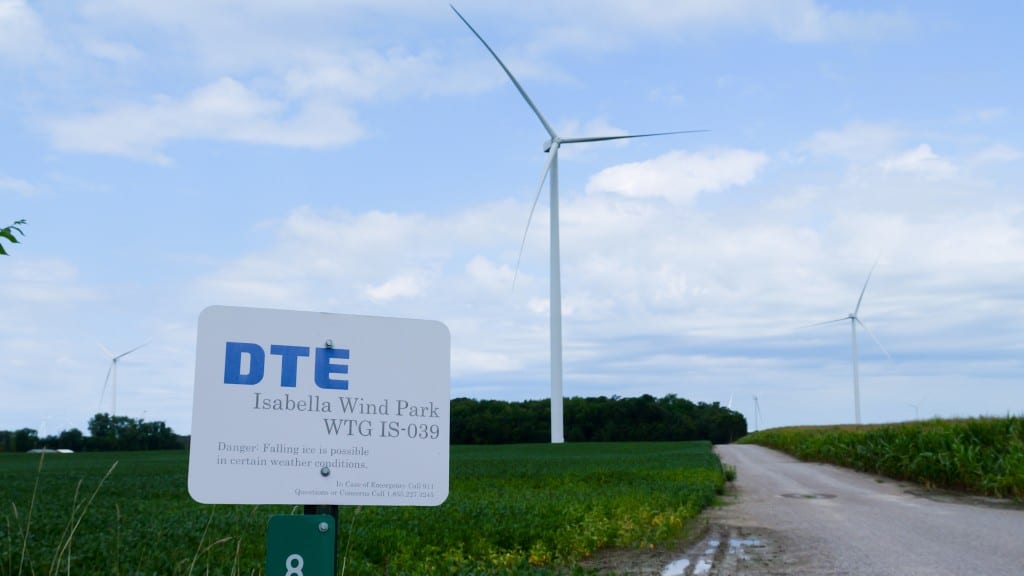
Isabella County is home to the largest wind farm in the state of Michigan.
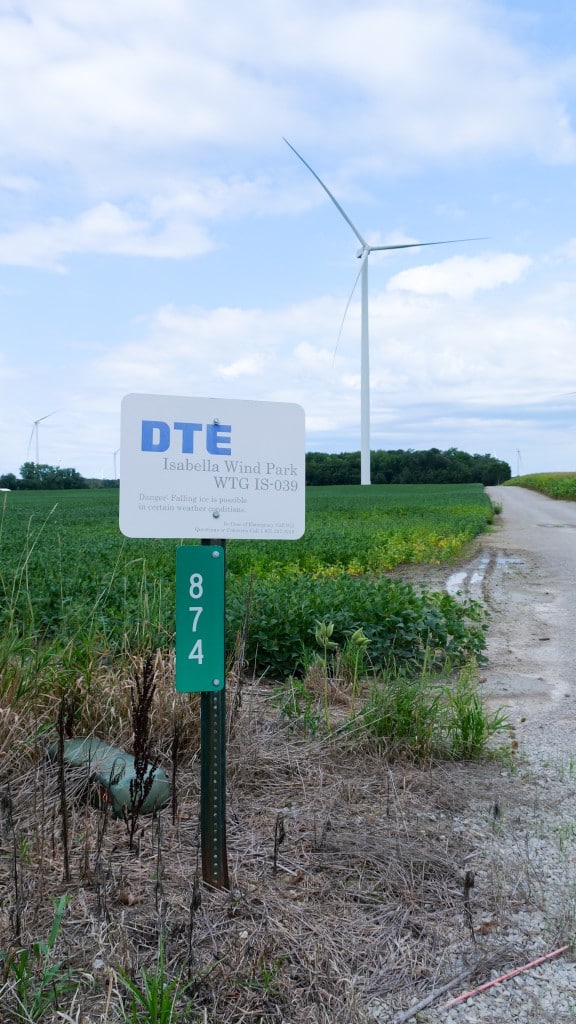
Known as the Isabella Wind Park, the state’s largest wind farm was originally developed as two adjacent single-phase wind parks in Rosebush, which started generating power in 2021, later to be combined as a 136 wind-turbine park in 2023.
Now five years into the wind park project, not only is Isabella County home to 172 turbines which generate enough energy to power approximately the equivalent of 150,000 homes (contributing to the 1 million homes across the state powered by wind energy), but the project is generating revenue for local landowners and local schools—making a significant positive impact.
Middle Michigan Development Corporation (MMDC) and 5 Lakes Energy worked together to evaluate the benefits of wind generation to Isabella County and its constituent communities over the past five years, discovering the largest recipients of revenue in Isabella County are county property owners and its school districts.
“Five years ago, we saw the potential the Isabella Wind project could bring to our region,” says Kati Mora, president and CEO of Middle Michigan Development Corporation. “Today, 172 turbines later, we have an opportunity to ask a very important question: How have those investments actually delivered for Isabella County and Middle Michigan?”
“That is exactly what this study with 5 Lakes Energy helped us understand,” Mora continues.
“Five years of wind energy in Isabella County has brought in more than $37 million in new tax revenue for local schools, townships, and county services,” explains Mora. “Wind-related tax revenue has made up between 10-20% of all property tax revenue generated in Isabella County. This study shows that the economic benefits of these projects are real and long-lasting for communities that choose to host them.”
“For us, this isn’t simply about wind energy. It’s about measuring the long-term economic impact of major investments in our communities—what they contribute, who benefits, and what their presence means five years down the road,” she says. “We believe economic development decisions should be grounded in data, and this study gives our communities a clearer picture of the economic activity and ongoing value associated with these investments.”
“Five years later, we can move beyond projections and look at what has actually happened. That perspective is incredibly valuable as Middle Michigan considers how we attract investment, strengthen our communities and build an economy that works for the people who live here,” says Mora.
Impact on Isabella County Property Owners
While property lease rates vary across time, geography, and are subject to non-disclosure agreements between wind developers and property owners, MMDC and 5 Lakes Energy found there is enough consistency in lease rates in order to estimate a range of expected income being earned by property owners hosting turbines across the county—stating landowners are bringing in between $1.2 million and $3.8 million per year in lease revenues.
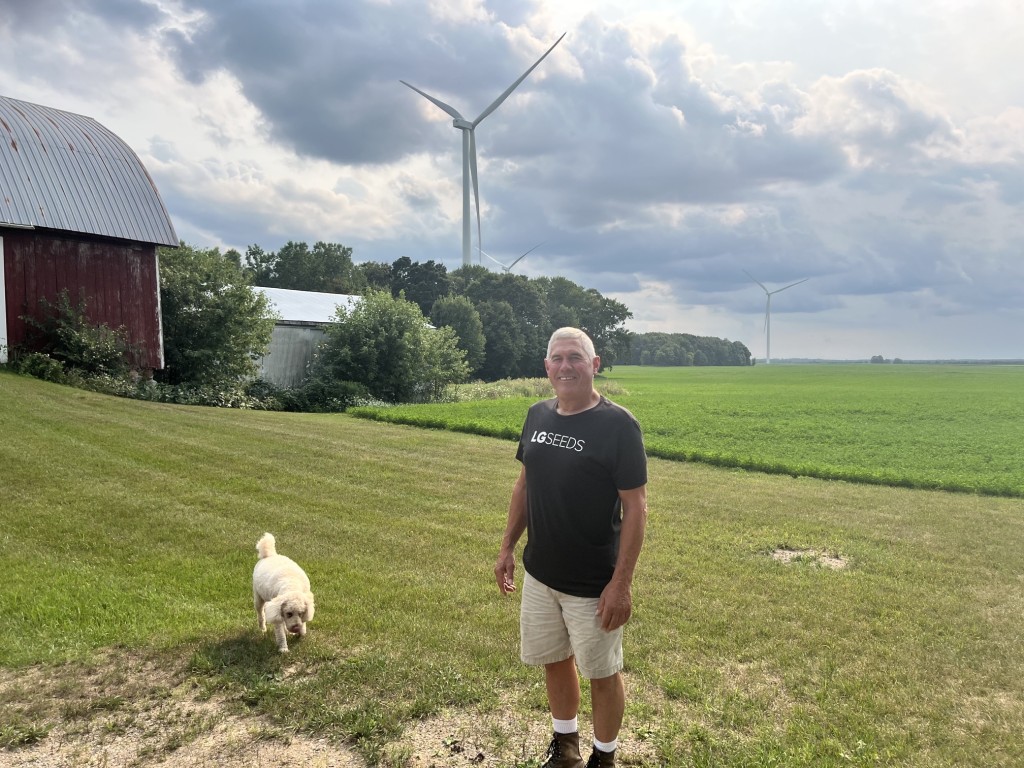
Stephen Gross, co-owner of Gross Farms, Inc. in Beal City, is a property owner who is receiving some of this revenue. He has been involved with the project since the beginning.
The goal, according to Gross, was that he was “hoping for financial stability.”
“We did our homework. We had a vision and we trusted our gut and went with it,” he shares of what influenced him and others to be involved in the project. “We really wanted the whole community to benefit.”
Fast forward five years later from those original thoughts, Gross says he has no regrets and is continuing to see a positive impact throughout the community.
“The community is still seeing the positive impact,” he explains. “If you have kids, you can definitely see the school benefit.”
Impact on Local School Districts
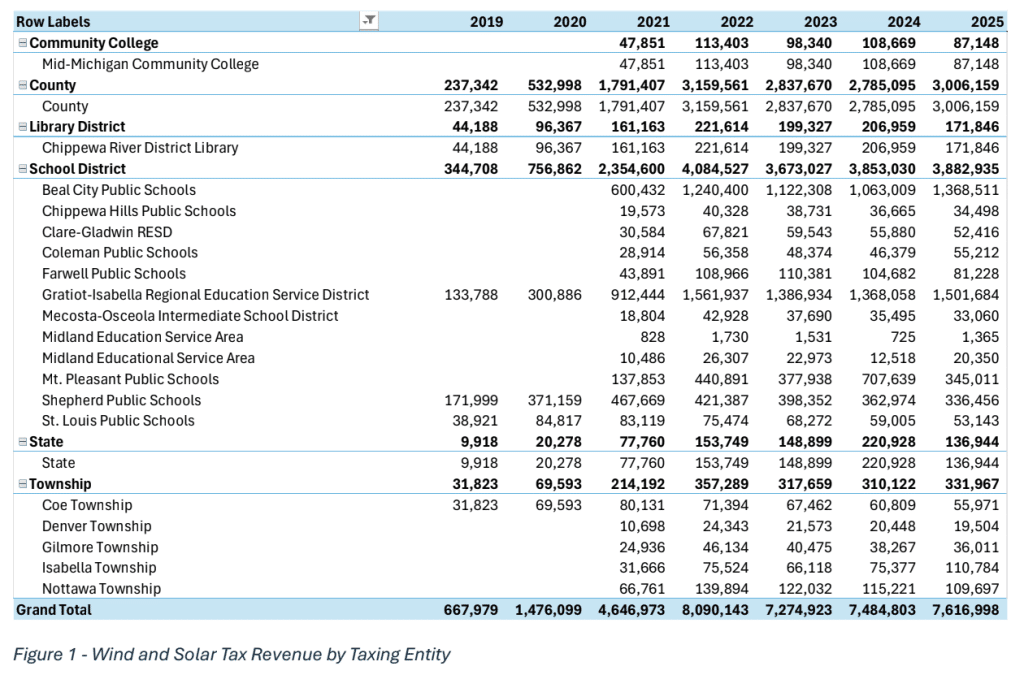
11 school districts in Isabella County receive renewable energy tax revenue. They are able to use these funds to update facilities, pay debt down faster, and potentially reduce millage requests to save taxpayers money.
These districts include: Beal City Public Schools; Chippewa Hills Public Schools; Clare-Gladwin RESD; Coleman Public Schools; Farwell Public Schools; Gratiot-Isabella Regional Education Service District; Mecosta-Osceola Intermediate School District; Midland Education Service Area; Mt. Pleasant Public Schools; Shepherd Public Schools; and St. Louis Public Schools.
According to MMDC and 5 Lakes Energy’s findings, Beal City Public Schools and the Gratiot-Isabella Regional Education Service District receive the highest amounts among Isabella County school districts.
Beal City Public Schools superintendent, Jason Wolf, who came on staff in 2025, recognizes “they are reaping the benefits as their tax base has tripled.”
In fact, Rod Freeze, Beal City Public Schools CFO, shares that the tax base went from $90 million to $300 million since the installation of the turbines.
“Even with depreciation, it allows us to pay our debt down faster,” says Freeze. “The funds don’t go towards operating costs, but any millage or bond we have, it allows us to pay down that debt faster and we don’t need to use our general fund for bonded projects.”
“Before the project kicked off we didn’t really know how much revenue it would bring in. We just knew it would help us,” he recalls of the beginnings.
Also involved in the early phases was previous Beal City Public Schools superintendent, Bill Chillman. “I learned as much as I could and focused on the facts.”
Now years into the project, Freeze says, “We’ve been able to do in five years what would’ve previously taken 25 years to do.”
Wolf echoes those sentiments, as the current Beal City Public Schools superintendent, he sees the impact daily, firsthand.
“[It] makes a huge impact on what we can offer,” he shares. “We can provide a world-class education and provide it in a building that our community can be proud of.”
“We have been able to update facilities and maintain them while also reducing the tax burden of our taxpayers,” Wolf continues. “We believe that for our next millage we can potentially reduce our 7-mill request down to 6 mills.”
“We are also looking out for the taxpayer and working to not waste the taxpayers dollars,” Chillman adds. “These guys have the community’s back.”
Additional Community Impact
Initially when the Isabella Wind project began, misconceptions throughout the community ranged from “Is there a diesel engine running these things?” to others expressing frustration.
However, those close to the project have noticed a shift in the community’s perspective.
“I started out asking ‘how do we stop this,’” says Isabella Township Trustee and farmer, Bob Walton. Walton became involved as a Township board member at first, followed by being impacted as a property owner. “But then I came around to it.”
“I toured [a project] in Huron to ask questions and approached it from a neighborhood standpoint and talked to others,” he recalls. “The approach we took was a community leasing model which was new at the time, but is now how it’s done in most places.”
“We’ve seen new stores come in as well as growth and expansion of local farms,” Walton observes about the impact he’s seen.
Gross agrees.
“The integrity and character of the community has stayed the same,” Gross says of the community growth. “We want to stay rural, we want to stay the way we are.”
He believes the economic growth for businesses in Beal City specifically, has been impacted as well.
“The three eateries/businesses in town see increased traffic because of it,” he perceives, noting those who maintain the turbines come to the area, buying food and spending money at local establishments.
“The community is still seeing the positive impact—it’s not going down,” he says.
Editor’s Note: When the story was originally published, it stated, “Now five years into the wind park project, not only is Isabella County home to 172 turbines which generate power to over 150,000 homes in the county (contributing to the 1 million homes across the state powered by wind energy), but the project is generating revenue for local landowners and local schools—making a significant positive impact.” It was corrected on Sept. 9, 2026 at 4 p.m. to the following: “Now five years into the wind park project, not only is Isabella County home to 172 turbines which generate enough energy to power approximately the equivalent of 150,000 homes (contributing to the 1 million homes across the state powered by wind energy), but the project is generating revenue for local landowners and local schools—making a significant positive impact.”
Author

Related Articles
Tourism banquet honors local businesses, invests over $115K in community projects
Papa’s Pumpkin Patch received the 2026 Meet Mt. Pleasant Tourism Award during an annual celebration recognizing the people and organizations supporting tourism in Isabella County. The event also highlighted tourism’s $354 million economic impact, awarded grants to community projects, and recognized local hospitality leaders.

How today’s Mission Street construction supports tomorrow’s improvements
As drivers navigate traffic shifts and construction zones, many are wondering what’s changing along Mission Street. City officials break down the current resurfacing project, upcoming shared-use pathway plans, and the long-term vision for one of Mt. Pleasant’s busiest corridors.

Isabella Bank celebrates one year on Nasdaq in Times Square
Local representatives from Isabella Bank participated in the Nasdaq closing bell-ringing ceremony, celebrating one year since its Nasdaq listing.


