
Renaissance becomes Isabella County’s only Evergreen-designated school
Renaissance Public School Academy became the only school in Isabella County to earn Michigan Evergreen School designation through a student-led sustainability effort.
What began as a summer professional development opportunity for two Renaissance Public School Academy STEM teachers has grown into one of the region’s most significant sustainability achievements.
Renaissance recently earned the Michigan Evergreen School designation through the Michigan Green Schools program, which is the highest level of recognition awarded by the Michigan Department of Environment, Great Lakes, and Energy (EGLE). The designation recognizes schools that complete 20 or more environmental and sustainability initiatives across multiple categories.
According to Michigan Green Schools, Renaissance is currently the only school in Isabella County—and one of very few in central and northern Michigan—to achieve Evergreen status.
STEM teacher Amber Schneider, who led the initiative alongside fellow STEM educator Autumn Gairaud, noted the lack of participating schools in central and northern Michigan makes Renaissance’s accomplishment especially meaningful.
“Midland County has several schools involved, but when you look at Isabella County and the surrounding counties, there’s really a big void,” Scheider says. “It’s pretty exciting for us.”
Initially, the Renaissance team believed they might qualify for the Michigan Green Schools’ entry-level Green School designation. However, as students began collecting data and documenting the school’s existing sustainability efforts, they quickly realized they had the potential to achieve much more.
“We kept finding more and more things we were already doing and became confident we could reach Evergreen status,” Schneider notes.
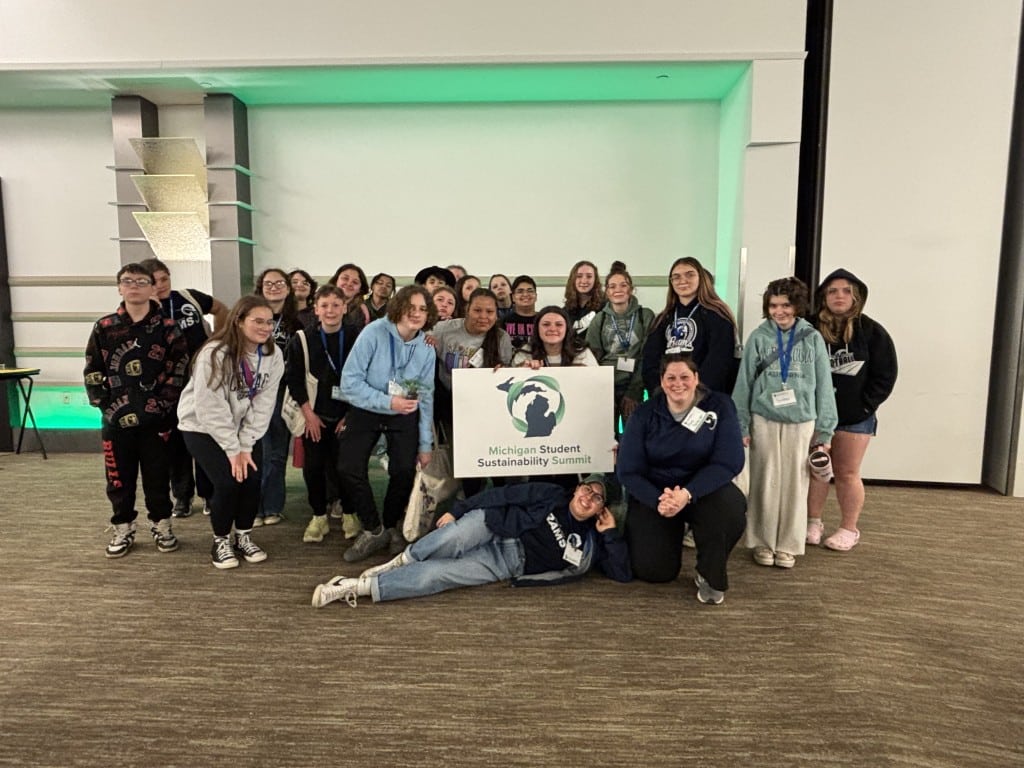
The achievement was driven largely by Renaissance’s seventh- and eighth-grade STEM students, who spent the school year researching, documenting and expanding the school’s sustainability initiatives. Through surveys, audits and application preparation, students played a leading role in earning the designation.
The idea originated after Schneider and her colleague participated in the Dow Sustainability Fellowship for Teachers last summer. During the fellowship, they learned about the Michigan Green Schools program and were inspired by a presentation from Dow High School educators.
After returning to Renaissance, the teachers invited interested students to help pursue the designation. Four students ultimately formed the school’s core Green School team, meeting weekly—and often twice a week during recess—to research, collect data and prepare the school’s application.
The students took ownership of much of the process.
“They built surveys for school staff, gathered information, analyzed the responses, and drafted the application themselves,” Schneider explains. “I went through and edited it, but this was truly student-driven.”
Their work revealed Renaissance had implemented 21 sustainability initiatives, qualifying the school for Evergreen status. Under Michigan Green Schools guidelines, schools must complete activities across four categories: Reduce/Reuse/Recycle, Energy, Environmental Protection and Miscellaneous environmental initiatives.
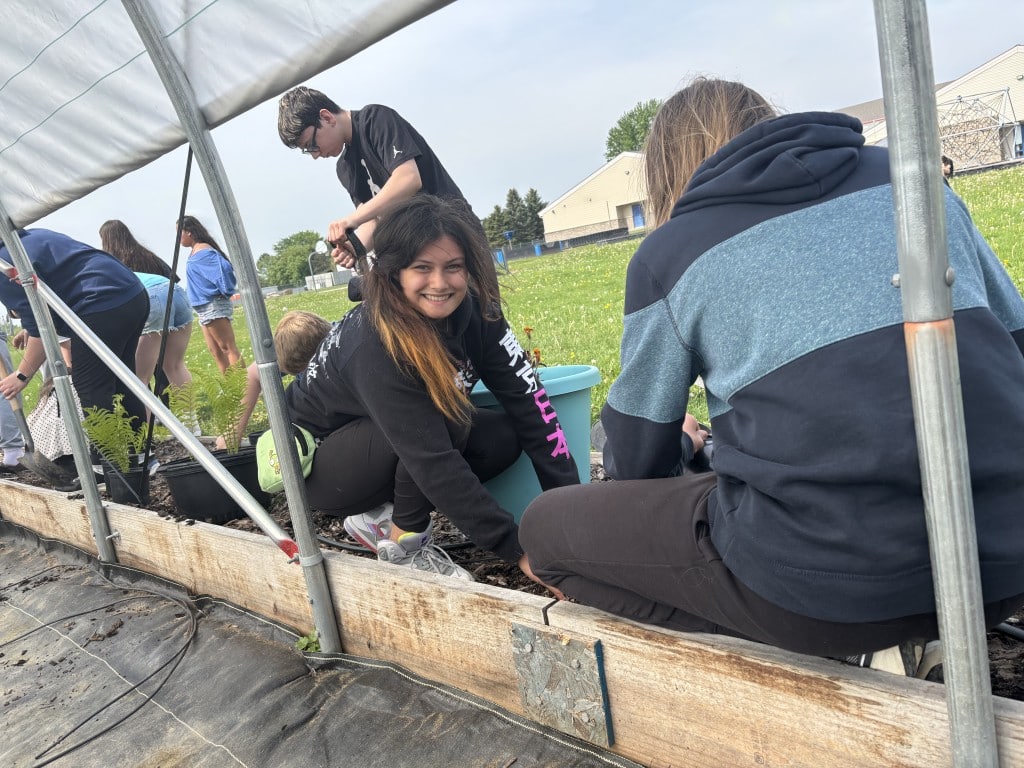
Among Renaissance’s qualifying projects are its well-known hoop house, a rain garden, sustainability-focused STEM curriculum, environmentally focused student organizations and a new composting program currently being finalized.
Notably, the school’s hoop house serves as both a learning laboratory and a food source. Produce grown there is incorporated into cafeteria meals when crops are in season, helping students see firsthand how local food systems work.
Students have also explored creative approaches to waste reduction through a sustainability club focused on upcycling and repurposing materials that might otherwise end up in landfills.
Another major project involves launching a schoolwide composting system. Once operational, compostable food waste from breakfast and lunch programs will be diverted from the trash and transformed into nutrient-rich compost for use in the hoop house.
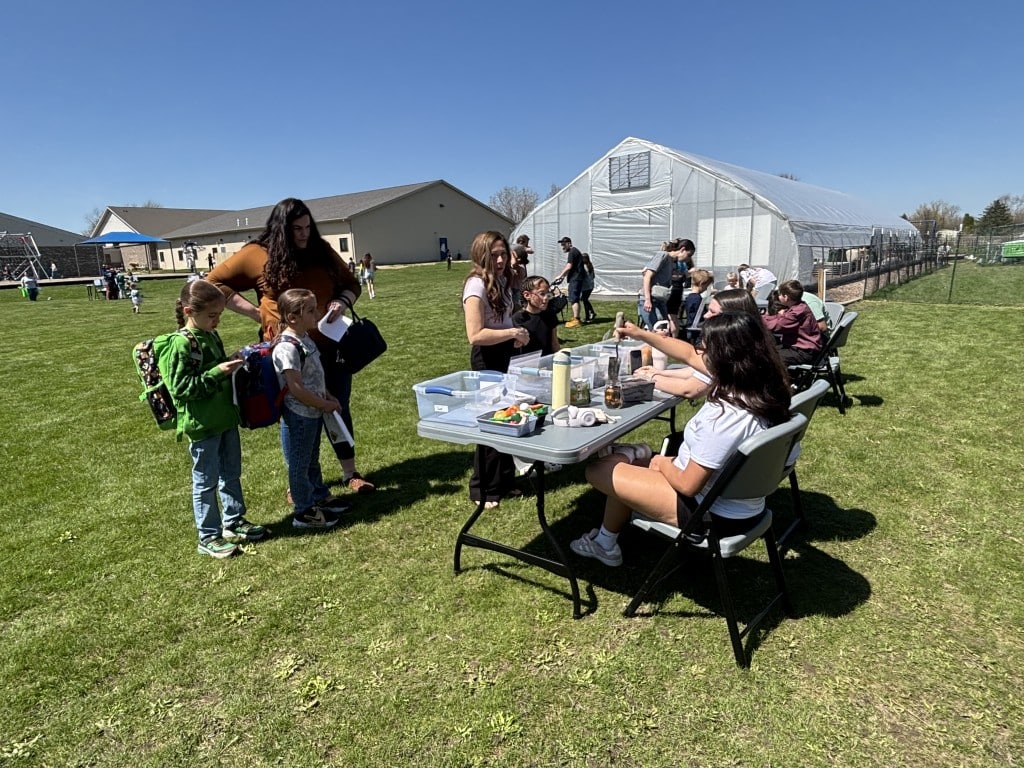
To build on these efforts, students planned and hosted a schoolwide Earth Day event that showcased many of their sustainability projects.
The event provided opportunities for students to educate classmates, families and community members about practical ways to reduce waste, conserve resources and make positive impacts on the environment, further extending the reach of the school’s sustainability efforts beyond the classroom.
“This year we even conducted a schoolwide waste and energy audit to kick off our awareness efforts,” Schneider adds. “It was amazing to realize how much waste there was, even in a school where we’re already conscious about sustainability.”
The audit became a powerful learning experience for students.
“They got to see firsthand how much was going into a dumpster that really didn’t have to be,” Schneider continues. “I think that’s something we can all take into consideration in our schools and in our homes. Can we compost on a small scale? Can we donate things instead of throwing them away?”
For Schneider, sustainability education extends beyond environmental science lessons. It is a personal passion she intentionally incorporates throughout her STEM curriculum.
“This year we built our STEM units around a sustainability focus,” she explains. “Everything we did, we tried to tie back to sustainability because it’s important to make sure we’re taking every initiative we can to reduce waste and reduce our impact on the environment.”
She says one of the most rewarding aspects of the project has been watching students develop the same enthusiasm.
“I love being able to pass that on to my students and see them have the same passion and excitement for taking care of the environment around us,” says Schneider.
When the school learned it had officially earned Evergreen status, students celebrated with a pizza party; rather than viewing the designation as a finish line, many immediately began discussing future goals.
“Their next step was, ‘Okay, what are we planning for next year?'” Schneider emphasizes. “They weren’t done once the application was submitted.”
Students have already discussed finding ways to encourage other schools throughout the region to participate in the Michigan Green Schools program.
The momentum is expected to continue this summer. While details are still being finalized, school leaders are planning several summer activities connected to the hoop house and other hands-on learning opportunities.
For Renaissance, Evergreen status represents more than a recognition plaque. It reflects a school culture where students are empowered to identify problems, collect data, develop solutions and make a tangible impact on their community.
Author

Related Articles

Partner Partner Content Five years in, Isabella Wind Park revenue is reshaping local school and farm finances
Five years after Michigan’s largest wind farm began generating power in Isabella County, its economic effects are becoming clearer. A new analysis finds the project is generating millions in estimated annual lease revenue for landowners while expanding the tax base for local school districts, helping some pay down debt and improve facilities.

New efficiency-enhancing equipment coming to Isabella County recycling center
Isabella County’s recycling center will replace its aging baler in August using more than $500K in federal grant funding secured through a partnership with the Saginaw Chippewa Indian Tribe. Officials say the investment should reduce maintenance concerns and prepare the facility for future improvements, though some recycling services will temporarily pause during installation.
How one local environmental expert helps protect Michigan’s aquatic systems
As an environmental quality analyst with the state and a volunteer with the Chippewa Watershed Conservancy, Blake Cahill blends science, service, and community engagement to safeguard native ecosystems and reconnect people with the natural world around them.


