
Local cyber security experts, colleges work together to encourage next generation of analysts
With technological advances and the cyber threats that accompany them, it’s predicted that there will be a faster-than-average growth rate in the employment of information security analysts. To meet that demand, local cyber security experts and colleges are working together to encourage students to explore a career in the field.
With the growing use of technology in day-to-day business operations, more and more businesses are finding themselves in need of protection against cyber threats.
“Because it’s so intertwined, every field needs to have someone who’s an expert in cyber security,” says Lt. Tyler Goode, U.S. Army Military Intelligence Officer stationed at Central Michigan University Reserve Officer Training Corps (CMU ROTC).
The last two decades alone have seen major technological advances that have had drastically impacted businesses, as well as individuals – advances such as the invention of smartphones, launch of Facebook, and growth of cloud-based storage. Given the current trajectory of technological advances, and the cyber threats that accompany each one, Goode adds that he predicts every company will have a cyber security expert within the next 5-10 years.
The Bureau of Labor Statistics echoes that prediction with the projection of a 32% growth in the employment of information security analysts by 2028, a much faster growth rate than the average for all occupations. The BLS adds that the percentage is even higher for those in computer systems design.
“Employment of information security analysts is projected to grow 55% in computer systems design and related services from 2018 to 2028,” states the BLS website. “The increasing adoption of cloud services by small and medium-sized businesses and a rise in cybersecurity threats will create demand for managed security services providers in this industry.”

That projection is one of the many reasons Delta College’s recent designation as a National Center of Academic Excellence in Cyber Defense Education is of particular importance to students in the Great Lakes Bay Region.
Delta College is one of 11 Michigan colleges to have received the designation, which is sponsored by the U.S. National Security Agency and the U.S. Department of Homeland Security. Because of this designation, students in Delta College’s program are eligible to apply for scholarships and grants through the Department of Defense Information Assurance Scholarship Program and the Federal Cyber Service Scholarship for Service Program.
To help meet the projected demand for information security analysts, Central Michigan University is also working to make students aware of the employment opportunities that could await them in the field of cyber security. As part of that effort, CMU hosted a panel discussion with local industry experts on Cyber Security Awareness Day, Oct. 11.
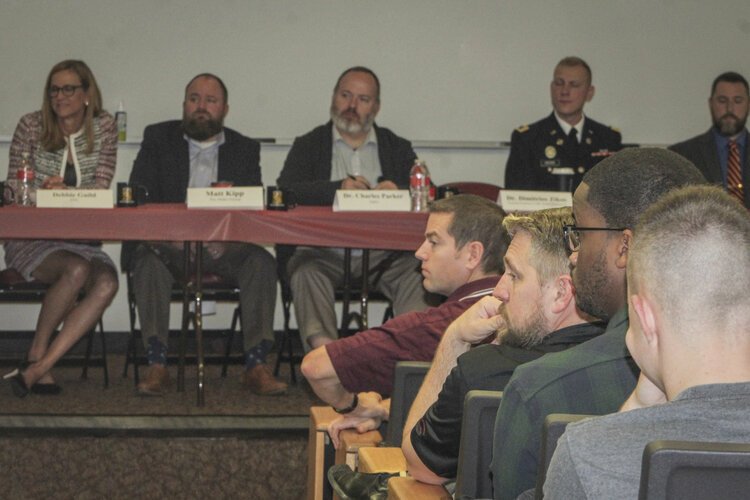
During the discussion, Anthony Mitchell, Cyber Defense Leader at Dow, encouraged students to pursue a career in the cyber security.
“The threats evolve as the technology evolves,” he says. “So, it really fits for that person who has a continuous appetite for learning.”
Denise McBride, senior lecturer in the Business Information Systems Department at CMU, hopes women in particular will begin taking more of an interest in the field.
“It is a male-based field,” she says. Of the seven panelists present during CMU’s Cyber Security Awareness Day, one was female.
McBride says, “It is important to balance the field because of the diversity of thought.”

One way CMU encouraged students to dive into the world of cybersecurity on Cyber Security Awareness Day was to host a capture the flag simulation game, during which students had to utilize various hacking and defense skills in order to correctly answer questions, and therefore capture a flag. Flags were located across the world on a digital map that students received, and each flag was worth a different number of points based on the level of difficulty to capture it. Challenges ranged from analyzing pictures for hidden words to attacking a website, and everything in between. The team with the most points at the end of the game won.
“It’s a game, but you develop skills playing that game,” says McBride.
McBride added that over 50 students registered to play the game, one of whom was Joshua Marzic, president of the Cyber Security Club at CMU.
“It’s ok to read something, but reading something doesn’t make it stick,” Marzic says. “You get to go be the bad guy without any consequences – and there’s prizes of course.”
Mitchell, who is a certified ethical hacker, adds, “These capture the flag events create an avenue for participants to understand how adversaries are approaching data.”
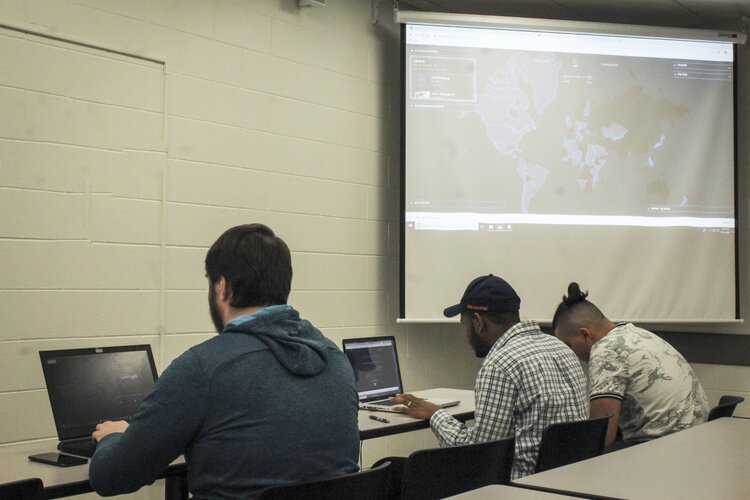
As a certified ethical hacker, Mitchell helps businesses pinpoint where their weaknesses are and establish actual risks that businesses are exposed to. He says, aside from fighting against phishing and malware, one of the biggest challenges facing cybersecurity experts is finding ways to work with the inherent flaws in the technology that is used every day.
“How do I build an ecosystem that allows me to use those technologies while protecting against adversaries?”
That’s a question students like Marzic, who is majoring in Information Technology and would like to pursue a career in cyber security, may be able to help answer one day.
Author

Related Articles
Mt. Pleasant High School Robotics team heads to world competition
The Mt. Pleasant High School Robotics team is advancing to the 2026 FIRST Championship, marking a rapid rise in a highly competitive global field. Beyond competition, the program is building a growing K-12 pipeline that gives students hands-on STEM experience and pathways into engineering careers.
Students are speaking up. And schools are listening.
The Gratiot-Isabella RESD Student Leadership Community initiative empowers students from 12 area schools to develop leadership and collaboration skills while elevating student voices to better inform and strengthen local education experiences.

Clare wildlife museum preserves Wayne Webber’s legacy through conservation education
What started as one man’s private collection has turned into a public wildlife museum striving to share his legacy while educating about the importance of wildlife conservation.


